Policy Analysis in Turkey by Caner Bakir & Günes Ertan
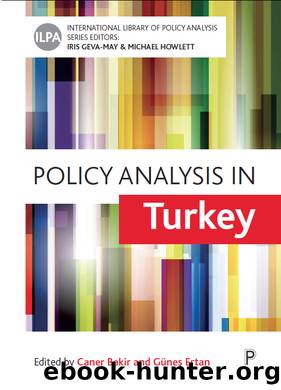
Author:Caner Bakir & Günes Ertan [Bakir, Caner & Ertan, Günes]
Language: eng
Format: epub
Tags: Political Science, Public Policy, General, Public Affairs & Administration
ISBN: 9781447347217
Google: gfpdDwAAQBAJ
Barnesnoble:
Goodreads: 40395840
Publisher: Policy Press
Published: 2018-06-06T00:00:00+00:00
The role of experts in the policy process in Turkey
As summarised earlier in Chapter Two (this volume), the Turkish Ottoman history has a rich tradition and experience in utilising expert knowledge. In a similar vein, 19th-century modernisation efforts enjoyed the considerable contribution of foreign experts, not only in the military, engineering and medicine, but also in other areas including music (Kaya, 2002). The young Turkish Republic also resorted to experts in its modernisation efforts in areas ranging from forestry to education and infrastructure to health. The rise of public policy analysis in the US during the postwar era also had a number of repercussions on Turkish politics and policy processes such as the establishment of the State Planning Organization (SPO), and its implications on the policy process have been well documented. Although several opportunities existed on the part of Turkish bureaucracy to develop a policy framework along the lines of the new methods developed by public policy analysis, the reluctance of politicians in handing power over to the bureaucrats and technocrats, say the experts, made it difficult to attain.
The 1980s witnessed a breakthrough concerning the state tradition. For some commentators, post-1980 developments paved the way for using experts in a number of domains. In the post-1983 period in particular, Turgut Ãzal's governments resorted to experts to reorganise the state through more technical and rational lines. In this process politics was shaped around a discourse of 'rational principles and techniques' in parallel to Ãzal's developmentalist and pragmatic ideas. A new breed of experts with expertise in domains, ranging from academia to media, had started to gain power in the political realm (Åahan, 2013, pp 130â1). As detailed in Chapter Two (this volume), the 1980s and 1990s witnessed the introduction of a new type of experts employed in newly established agencies to bypass traditional bureaucracy and inform the policy process. A number of other regulations and reforms in the public sector were also introduced in the early 2000s as part of austerity measures imposed by donors and the European Union (EU) accession process, including strategic planning and regulatory impact assessments.
For some other commentators, a number of other factors also contributed to the rise of experts and expertise in the policy process in Turkey. For Keskin, a number of other factors such as the qualitative and quantitative changes in mass communications, the development of international cooperation and partnerships and the rise of new social movements generated a demand and contributed to a rise in the number of experts and use of expertise. Proliferation of media outlets contributed to the rise of a new breed of investigative journalism; independent research and consultancy firms increased their customer portfolios; and professional election campaigns also required a new type of experts and expertise. Furthermore, a number of players in the political arena started to look for expert knowledge in their respective domains. For instance, left and liberal political movements, their foundation and associations, civil society organisations (CSOs), professional chambers, trade unions, pressure groups, international/transnational organisations and corporations
Download
This site does not store any files on its server. We only index and link to content provided by other sites. Please contact the content providers to delete copyright contents if any and email us, we'll remove relevant links or contents immediately.
| Anthropology | Archaeology |
| Philosophy | Politics & Government |
| Social Sciences | Sociology |
| Women's Studies |
The Secret History by Donna Tartt(19086)
The Social Justice Warrior Handbook by Lisa De Pasquale(12190)
Thirteen Reasons Why by Jay Asher(8909)
This Is How You Lose Her by Junot Diaz(6885)
Weapons of Math Destruction by Cathy O'Neil(6279)
Zero to One by Peter Thiel(5801)
Beartown by Fredrik Backman(5754)
The Myth of the Strong Leader by Archie Brown(5507)
The Fire Next Time by James Baldwin(5442)
How Democracies Die by Steven Levitsky & Daniel Ziblatt(5218)
Promise Me, Dad by Joe Biden(5153)
Stone's Rules by Roger Stone(5087)
A Higher Loyalty: Truth, Lies, and Leadership by James Comey(4960)
100 Deadly Skills by Clint Emerson(4924)
Rise and Kill First by Ronen Bergman(4788)
Secrecy World by Jake Bernstein(4752)
The David Icke Guide to the Global Conspiracy (and how to end it) by David Icke(4717)
The Farm by Tom Rob Smith(4507)
The Doomsday Machine by Daniel Ellsberg(4490)
